




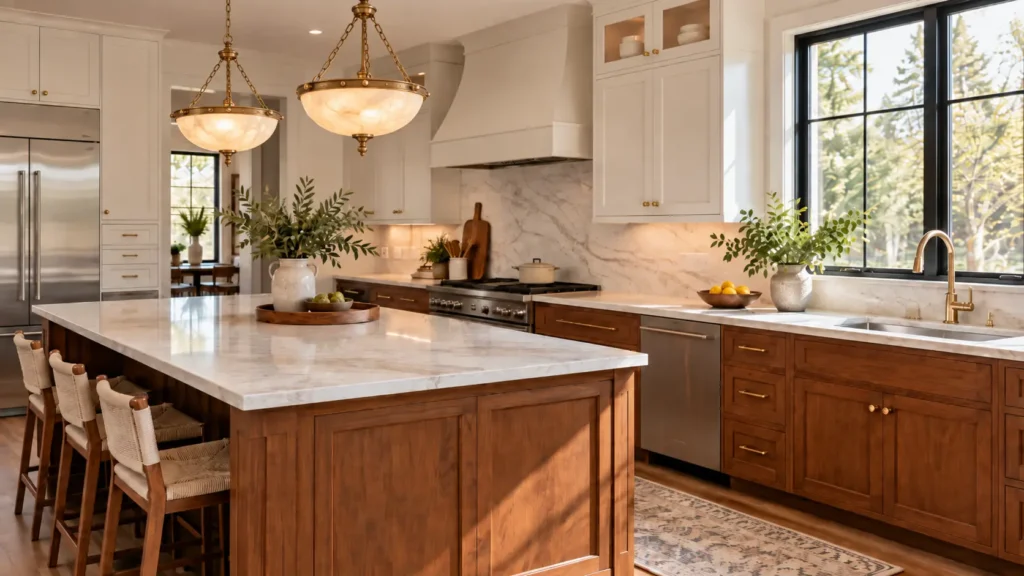
If you like your existing countertops but your kitchen cabinets are worn, dated or no longer working well for your needs, you may wonder whether you can replace the cabinets without replacing the countertops too. In some kitchens, yes. Existing countertops can sometimes be removed, protected and reinstalled over new cabinets. But whether that makes sense depends on the countertop material, how it was installed, the condition of the cabinets and whether you want to change the kitchen layout.
For Long Island homeowners trying to decide where to invest their remodeling budget, keeping a countertop you still like can sound like an easy way to save money. The challenge is that countertops and cabinets are installed as part of the same system. Changing one can affect the other.
Why Replacing Cabinets Under Existing Countertops Can Be Complicated
Kitchen countertops are normally installed after the base cabinets are secured, leveled and positioned. Stone countertops such as quartz, granite and marble may be held in place with adhesive and supported by the cabinets below. Sinks, plumbing, backsplashes and appliances can make removal even more complicated.
To replace the cabinets while keeping the countertop, contractors generally need to remove the countertop without damaging it, install the new cabinets in compatible locations and then reinstall the countertop. That sounds straightforward, but stone slabs are heavy and relatively brittle. Once installed, they are not designed to be repeatedly removed and moved around.
Can Countertops Crack When Cabinets Are Removed?
Yes. Cracking is one of the main risks involved in trying to reuse an existing countertop. Quartz and granite are durable when properly supported, but that does not mean they are impossible to break. Weak points can occur around:
- Sink openings
- Cooktop cutouts
- Narrow sections of stone
- Seams
- Overhangs
- Previously repaired areas
The larger and more complicated the countertop configuration, the more difficult it may be to remove it intact. Even when a countertop looks perfectly sound, there is usually no guarantee that it can be removed and reinstalled without damage.
Can New Cabinets Be Installed Under Existing Quartz Countertops?
Sometimes. If the quartz is in good condition and the new cabinet configuration closely matches the existing one, reuse may be possible. The new cabinets must provide the proper height, support and footprint for the existing slabs. This tends to be much easier when you are replacing cabinets in essentially the same locations.
For example, replacing a 36-inch sink base with another 36-inch sink base is generally more compatible with countertop reuse than changing the entire sink area or moving appliances.
Homeowners considering new cabinetry can also visit a kitchen and bath showroom to compare cabinet configurations, door styles, finishes and storage options before deciding whether keeping the existing countertop still makes sense.
Does the Kitchen Layout Have to Stay the Same?
Not necessarily, but reusing countertops places significant limits on how much you can change. Existing countertops were fabricated for the exact cabinet arrangement currently underneath them. Cutouts, seams, wall dimensions and appliance openings were all determined by that layout. You may be able to make small changes, but major changes can create problems.
For example, it becomes much harder to reuse the countertop if you want to:
- Move the sink
- Change the size of the sink base
- Move the dishwasher
- Add or remove cabinet sections
- Change an appliance opening
- Expand the countertop
- Move or resize an island
- Change from a peninsula to an island
If improving the layout is one of your primary reasons for remodeling, designing the new kitchen around an old countertop can limit some of your best options.
Keeping the Countertop Can Affect Your Cabinet Choices
Cabinets come in many sizes and configurations, but the cabinets you choose need to work with the countertop dimensions you already have. That can mean making compromises.
You might find a cabinet arrangement that provides better drawer storage or makes better use of an awkward corner, only to discover that changing the cabinet widths would no longer line up properly with the existing countertop. This is why cabinet planning should happen before assuming the countertops will stay.
LPS Direct offers a range of kitchen cabinetry options that can be incorporated into a complete kitchen design. Looking at the cabinet layout as a whole can help determine whether preserving the existing countertop improves the project or unnecessarily restricts it.
What About the Backsplash?
The backsplash is another factor homeowners sometimes overlook. If tile sits directly on top of the existing countertop or overlaps its edge, removing the countertop may disturb the bottom row of tile. In some kitchens, removing the countertop without damaging part of the backsplash can be difficult.
If the backsplash is already dated or scheduled for replacement, this may not matter. If you hoped to keep both the countertop and backsplash, however, the installation should be carefully evaluated before work begins.
When Does Keeping the Existing Countertop Make Sense?
Reusing countertops tends to make the most sense when:
- The countertop is still in excellent condition
- You still like the material and color
- The current kitchen layout works well
- Cabinet locations will remain largely unchanged
- Appliance sizes and locations will remain the same
- The countertop can be removed safely
- The cost savings justify the added limitations
A newer quartz or granite countertop paired with cabinets that simply did not age as well may be a reasonable candidate.
When Is Keeping the Existing Countertop Not Worth It?
There are also situations where saving the countertop can create more compromises than savings. It may be better to replace it if the countertop is damaged, badly stained, cracked or already nearing the end of its useful life. Replacement may also make more sense when you want to significantly improve the kitchen layout.
For example, imagine that keeping the existing countertop saves some money but prevents you from adding better drawer storage, enlarging an island or improving the work area around the sink. You could end up designing an entirely new kitchen around one older component. That is not always the best long-term value.
Consider the Entire Kitchen Before Making the Decision
The question is not simply whether the countertop can be saved. A better question is whether keeping it helps you create the kitchen you want. If the existing countertop fits naturally into the new design, reuse may be worth exploring. If it forces compromises in cabinetry, storage, appliance placement or layout, replacing it may give you far more flexibility.
Before ordering cabinets, have the existing countertop, cabinet configuration and proposed layout evaluated together. That can prevent an expensive surprise once demolition begins.
Planning a Kitchen Remodel on Long Island?
If you are considering new cabinets but are unsure whether your existing countertops can stay, LPS Direct can help you look at the kitchen as a complete design rather than making each decision separately.
You can visit the LPS Direct kitchen and bath showroom to explore cabinet styles, finishes and kitchen design options and discuss how your existing countertop may fit into the project.


